


December 18, 2025
DME MAC Program Manager Update – How to Respond to Comprehensive Error Rate Testing Requests and Prevent Denials
The Comprehensive Error Rate Testing (CERT) program evaluates the accuracy of Medicare Fee-for-Service (FFS) payments by reviewing a random sample of claims for compliance. Its goal is to identify improper payments and estimate the national improper payment rate. These findings help Medicare improve its processes, educate suppliers, and prevent future errors.
CGS and Noridian Program Managers regularly meet to find better ways to manage and improve the DME MAC program across all regions. In this update, we're focusing on helping suppliers understand why claims sometimes get denied by the CERT Contractor—and how to avoid those issues.
If your claim is selected, they'll ask you to send extra paperwork. What you send will help them decide if the claim was handled correctly or if there was a mistake.
Helpful tips when responding to CERT requests:
- Proof of Delivery
Make sure you have all documentation needed to show the item was delivered as outlined in the Standard Documentation Requirements for all Claims Submitted to the DME MACs Policy Article.
 - Practitioner's NPI
Double-check that the ordering practitioner's National Provider Identifier (NPI) on the claim matches the name of the practitioner who completed the order. - Incomplete Documentation
- Make sure everything is easy to read.
- Collect all needed information from the patient during intake.
- Make sure your records meet Medicare's requirements for the item billed.
- Incorrect Coding
- Your documentation should support the code and quantity billed.
- Use the correct modifier(s) when required.
- Medical Necessity
Include all relevant records, if they apply, such as:- Orders (standard and written orders prior to delivery)
- Notes from the treating or ordering practitioner
- Face-to-face visit records
- Medical history and physical exam
- Test results and findings
- Progress notes and treatment plans
- Proof of continued need and use
To avoid overpayments, follow these tips and respond quickly when CERT asks for documentation. *Use the CERT bar-coded cover sheet as the first page of your response.
Supporting Suppliers Through Education
To help suppliers succeed, DME MACs team up with A/B MACs to host webinars that focus on reducing Medicare claim errors. Each year, we present four sessions that explain what documentation is needed from prescribing practitioners for DMEPOS claims.
In 2025, the webinars covered:
- Urological Supplies
- Surgical Dressings
- Wheelchair Options and Accessories
- Parenteral Nutrition
These webinars are part of a larger effort to make sure claims are paid correctly. Since the accuracy of DMEPOS claims depends on the quality of orders and medical records, DME MACs will continue working with A/B MACs in 2026 to keep improving the error rate.
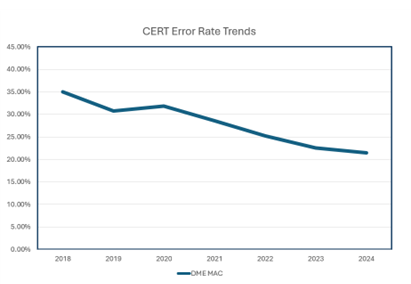
The graph below shows the error rate has significantly decreased over the years. This progress comes from ongoing education and suppliers taking an active role.
The DME MACs extend our sincere thanks to the supplier community for their commitment to complaint billing practices.
Finally, the DME MACs have many CERT educational resources on our websites:
Jurisdiction A: Comprehensive Error Rate Testing (CERT) - JA DME - Noridian
Jurisdiction B: Comprehensive Error Rate Testing (CERT) Program
Jurisdiction C: Comprehensive Error Rate Testing (CERT) Program
Jurisdiction D: Comprehensive Error Rate Testing (CERT) - JD DME - Noridian
 Join Electronic Mailing List
 Print
Print Bookmark
 Facebook
 YouTube
 LinkedIn
 CGS Medicare Mobile App